

Two excerpts from Atlas appear in the inaugural issue of Barren Magazine, August 2018: “Start by emergent terrain” and “What lies in the origin.”
Two excerpts from Atlas appear in the inaugural issue of Barren Magazine, August 2018: “Start by emergent terrain” and “What lies in the origin.”
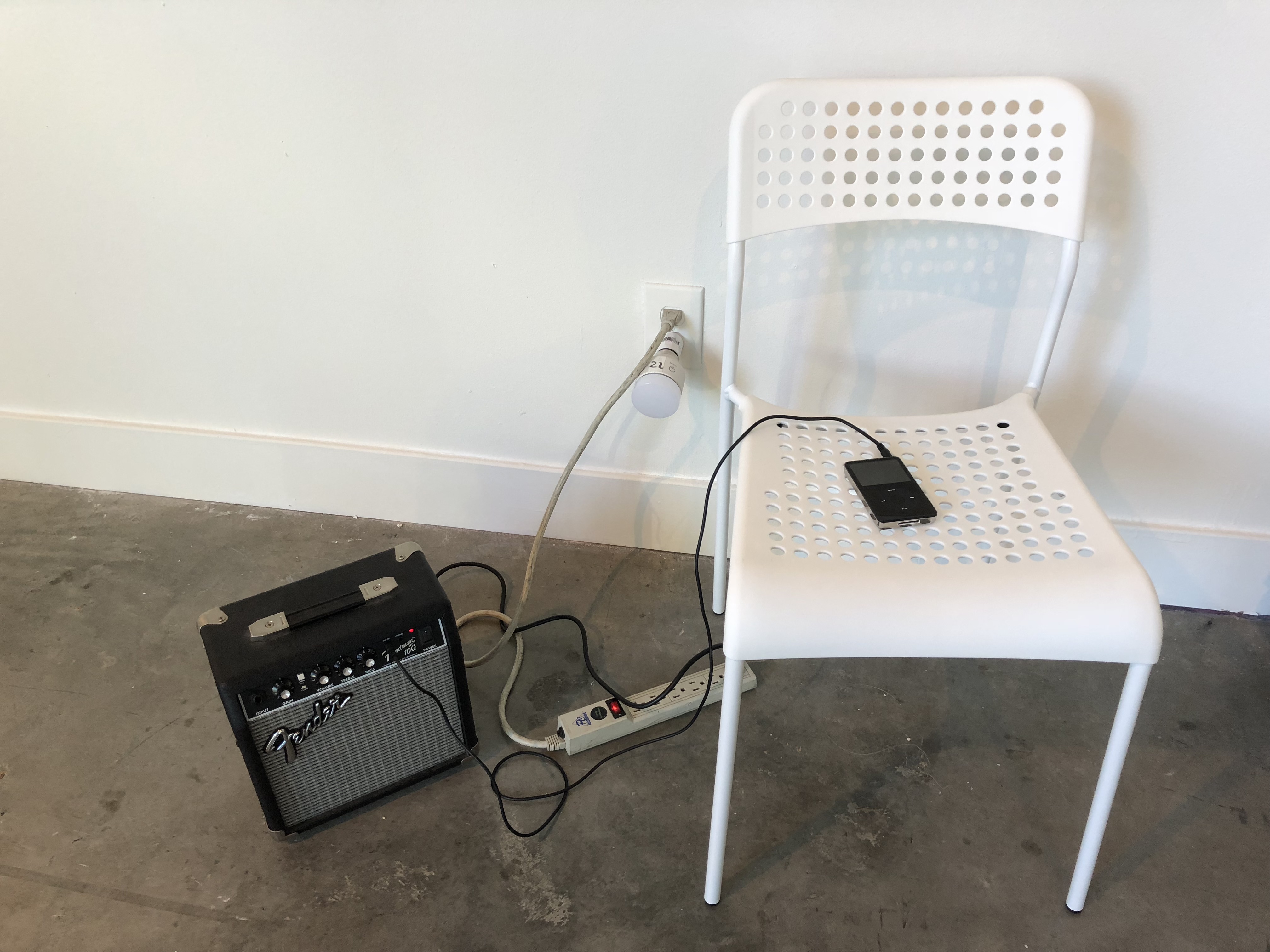
Southern California Soundscape Ensemble performed two sets as part of Flow | Obstruction, an exhibition curated by Carolyn Schutten at The Collaborative, 421 W. Broadway, Long Beach, 21 July 2018. Participating members: Glenn Bach, Jorge Martin, Marco Schindelmann, and Angela Willcocks.
Five excerpts from Atlas published in Experiential-Experimental Literature, 11 July 2018.
I performed a four-hour, improvised set at SoundPedro, Angels Gate Cultural Center, San Pedro, CA, 7- 11 PM, 2 June 2018.

Two excerpts from Atlas have been published in Sheila-Na-Gig, Volume 2.3, Spring 2018.
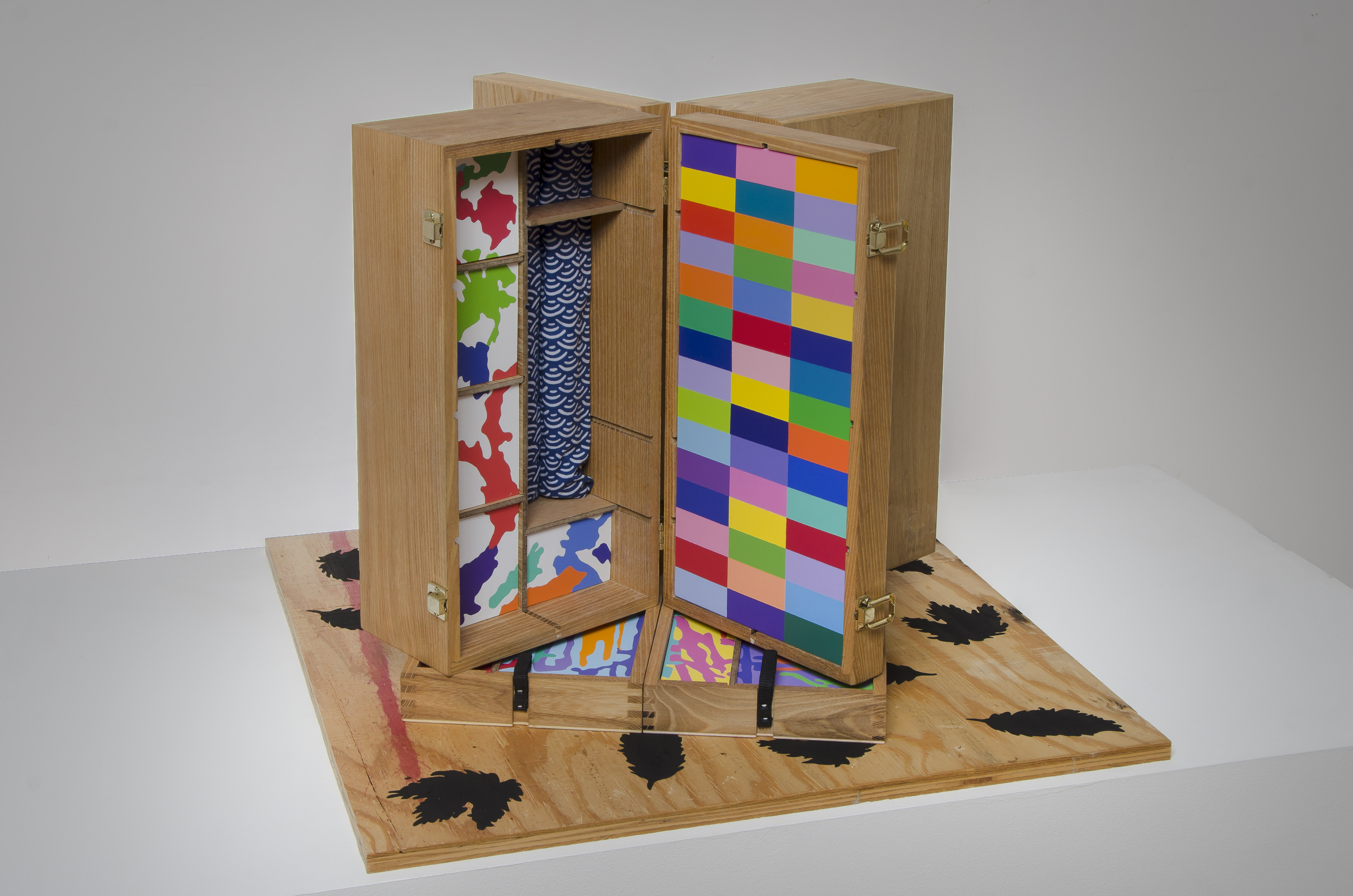
Part two of my conversation with artist and educator Tom Krumpak is now online at Imprintable.
This is part two of a conversation that took place in Tom’s faculty office in the Fine Arts 4 building (FA4) at CSULB on September 2, 2015. Read part one here.
Tom Krumpak has exhibited internationally since 1976. He earned a Master of Fine Arts Degree from California State University Long Beach and a Bachelor of Fine Arts Degree from the San Francisco Art institute. He has been a professor of drawing and painting at California State University, Long Beach since 1983.
All images courtesy Tom Krumpak and Jan Simonovic.
Glenn Bach: Going back to San Francisco…I’m sure we’ve talked about this before, that you have very strong ties to Mar Vista, and a house with your mom, and that neighborhood…if the position here at Cal State Long Beach did not happen, might you have settled in San Francisco rather than in Los Angeles?
Tom Krumpak: I don’t think so, no. Because I didn’t come here for this job. I left San Francisco because of a love affair gone bad, you know, a long-time love affair. So, the city is a weird place. It’s changed now, but it’s not a big place, physically, right? And, people have their ruts that they’ve grooved through the city, if you’re a lawyer or a doctor or an artist. So, the city wasn’t big enough for the two of us. Basically, that’s why I left.
Literally, every day that you get on a bus or public transportation, you see, within the mass of the public, similar faces over and over and over again. I just knew that city, which I loved deeply at that time…I loved the cracks on the sidewalks, I loved this house on this corner…as we talked about, you know, my place for coffee, my place for drinking at night. I loved the music in the jukebox at this place, you know, only opera on this jukebox in this bar on a particular night. I loved living in the Italian neighborhood. I loved living in the Haight, in the post Haight-Ashbury time, by the park. I loved that city. For me, that city was another body. I really loved it.
I was educated there at the Art Institute, too. I matured…I guess you would say ‘mature.’ I lived in a commune. In our Victorian flat, there were nine people paying rent, and at least another nine or ten people who were hanging on. There were terrible moments and great moments, but, man, it was in the moment. Some of us were musicians, and we played in one part of the flat, even with all those people in it, and we painted in another room in the flat, and we lived in between them. We threw wild parties, and it was all good. I really loved that place.
But, when my personal life fell apart, it was time to leave. I don’t think I would have stayed in San Francisco. Matter of fact, I did try to go back after living in L.A. for a while, and tried to think about doing it again, and I stayed two days, and that was it. I knew I had been changed. My life had been altered. I was living in L.A. now.
The other place would have been New York, of course. It would have been New York. I think I could stop mourning for San Francisco, and all the intimate things that I loved there, the places and the stuff, when I went to New York. I saw that New York magnified San Francisco at that time, maybe six or seven times, and I felt like there was a big world of other stuff. I love sitting there. I could live there. So, I contemplated that for a while, which led to going there a couple times a year for the last thirty years.
Coming to L.A. was kind of the default. I could come here, and I could scrounge off my family and my friends until I got my act together. And then, down the line, I came to Cal State Long Beach, because John de Heras saw a show of mine in Hollywood, and he came to where I was working, my day job, and said, “You should be teaching at Cal State Long Beach.” I didn’t have my MFA degree, and he said, “Well, I’ll just be the chair of your committee; you should come here.” And I did. Then, after that, I started getting teaching positions, and here I am. Academia…I was thrown out of high school. Academia was not, for political reasons, in my purview. I was as surprised as anybody.
Bach: We live the life that we end up living, right? You can have these relationships with these cities, these deep, connected relationships with these places, but you don’t have to actually live there. San Francisco is part of who you are. You will always have this passion for the city, but you don’t have to actually live there. Go visit a couple times of year.
Krumpak: Have good friends there.
Bach: Good friends there, and you get your fill, and you see all the things that you want to do, and visit your people, and go to the places and drink the coffee, you know. Then you leave and you come back, and then it’s like, “OK, now I need to get my New York fix, so, I’m going to plan a trip and plan a week or week-and-a-half there,” and, then, down the road, “I think it’s time to get overseas again,” or whatever.
Krumpak: Sure, back to London.
Bach: Back to Italy or back to London. You accumulate these place relationships over the years that shift in importance in your life, or sometimes you have a falling-out with a place, like when I moved to New York, I thought New York was it. I’d experienced major cities…Rome was my first major city. New York was its own thing. At that time, I didn’t think very highly of San Francisco. I mean, I enjoyed San Francisco, but I thought, “Why would you want to spend time in San Francisco when you could be in Brooklyn and Manhattan, and there’s so much there?” It wasn’t until much later—actually, with Sharon, when I spent more time going up there—that it kind of shifted. I don’t think less of New York now, but San Francisco became something different for me, and I soon had different ways of accessing the city. Headquarters, I called them, the Tenderloin, that became these centers of intimacy and good memories for me. For you, there’s a wide variety of these places that function as extensions of who you are.
Krumpak: Right. I think that the idea of teaching and exhibiting in different places is really important, because it means that you’re doing something real there, not just ‘tourist-ing’ it or even sensitively walking around, which is fine too. But, you’re actually doing a job with other people who are doing a job. I think that’s really important.
And the people…if you’re lucky enough to meet some really great people in all these places…I’ve always valued the people in these different places. Maintaining those relationships, going back to ‘water’ them, you know, and to find out what’s happening with their lives, and to just slip into their lives a little bit for dinner or an evening of chatting and drinking or whatever. Or, seeing their show, flying back for an opening in New York for Josh [Dorman]’s show, or whatever. That’s really, super important. I really count on those people. Psychically, they’re in my head. They’re in the locations, and that charges all that stuff you’re talking about.
When I need to know something and I don’t know it, I call them, and I say, “Hey, I need to understand the pricing of my artwork, and I’ve been in this business for a long time. I don’t get it. Give me your advice. Just give it to me straight. Tell it to me the way you want. I’m listening.”
I just called Chris [Cook] in England, and I said, “I haven’t seen you in a long time. I need your poetry.” So, I just got a new book hot off the press. I wish I could see them in body more often, but at least we are still creatively and psychically in touch with each other. So, yeah. It’s like those places and their population of friends and creative people are super, super important. They humanize the whole thing.
Bach: Yes. So, Mar Vista.
Krumpak: [laughs] OK. The little burg.
Bach: You’ve been in that house…
Krumpak: Yep, over thirty years.
Bach: Your studio has been associated with that house for just…
Krumpak: Fifteen years.

Bach: That has an effect on, obviously, who you are and where you live. Having your studio in the place where you live, ten steps away, or twenty steps away. And, having your practice on the West Side, in Los Angeles…it’s a construct, right? Los Angeles is a construct. You’re part of this Southern California thing, but you’re also part of a neighborhood. There’s Los Angeles as a whole, then there’s the West Side as a smaller subset, and within that there’s Culver City, Marina del Rey, and within that there are these smaller neighborhoods like Mar Vista and Del Rey and Palms. There’s this sort of neighborhood reality that is different than in other neighborhoods. Maybe you could talk about what it is about Mar Vista that keeps you going and that keeps you frustrated and inspired and…
Krumpak: I grew up there. I came here from Ohio when I was ten, and we lived near the Santa Monica airport with my grandmother for a little while. My parents bought a house. I grew up from the age of 10 through 19, or whatever, in Mar Vista. That house, where my mother still lives, is five minutes away from where I live right now. She’s 90 years old. It’s a very unassuming neighborhood. It was a working-class neighborhood. Now, it’s an increasingly wealthy neighborhood up on the hill. It was always very regular. By that, I mean that people kept to themselves, and it was clean, and it worked.
My father built a business three minutes away from where he lived, and he would walk to work. He built his hardware store from scratch. He had somebody build the building for him, then he opened the business. He had been in business in a hardware store in Ohio before that, for many years, partnering with my mother’s sister’s husband.
We were really close and tight. The property that I live on now was the eccentric uncle’s house, who worked for the film studios. When he passed away, the sisters inherited it. It was rented for three years by a man who was a curator for The Getty, and then we purchased it. 1950s modernist house, slab-on-grade, glass at the back, kind of Japonisme on modern, which is a current interest in my work. So, you can see, there’s a lot of crossover going on here.

We raised both of our boys in the house with practically no heat, because we couldn’t afford it. We had one wall furnace that barely worked. When it rained, water came down the walls on the inside and we mopped it up. It became a clubhouse, because their friends, as they got a little bit older, grade school or whatever…all the stuff they couldn’t do at their house, they could do at our house, because it was completely indestructible, because it was all messed up. They could ride their bike in the front door and go straight through the living room and right out the back door, and nobody cared.
Bach: [laughs] Right.
Krumpak: They could run laps through the house and through the back yard and around the yard. It housed a lot of great memories. My wife Jan’s family also lived five minutes away, so, our children never had babysitters. They had the care of their grandparents. In that way, Mar Vista takes on a very personal geographic importance. It’s more than the place. It’s this proximity of family that is very important. When I left to move to San Francisco, I never thought in a million years I’d ever come back to L.A. Literally, never come back. I was as surprised by circumstances as anybody, especially that I’m this close.
Jan grew up five minutes away from where we live now. She never thought she’d live in L.A., either, let alone five minutes away from where she grew up. She was born in Long Beach, at the hospital there, and then moved to Venice, where she was brought up in what was a very working-class, post-war, small-house neighborhood that was very integrated. There were people…it was an international enclave. Up on the hill, where my parents were, is mostly white.
Where we live now, we live four blocks from a housing project. The street adjacent to us has become restaurant row for the new hipster overflow from Venice. We have literally four new bakeries. We have ten new restaurants within a five-minute walk. We have a place to have a beer, and everything else you can imagine. It doesn’t mean that my particular neighborhood up close is gorgeous, but it’s certainly not awful. Actually, it’s becoming very, very desirable for young people in the tech field now, because Playa Vista is, again, five minutes away. It brings thousands of techie people, for the good or the bad, to our neighborhood.
About ten years ago, L.A. did a survey of arts concentrations to figure out what kinds of arts resources should be allocated for the future needs of different neighborhoods. Ten years ago, Mar Vista had the densest concentration of artists of any place in the city. Who knows now. Because it doesn’t look like that, like Venice used to…which is, you know, way gone now. But, there are screenwriters and composers and musicians, like professional touring musicians…the guy who plays with the Kinks lives at the edge of my street. And painters, and people who go to work in all the movie studios in Culver City, and a lot of them are ten minutes away. So, it looks like Iowa, in a sense, but, in fact, is just chock full of intellectual, visual types, and musical types. It’s a camouflaged zone, in a sense.
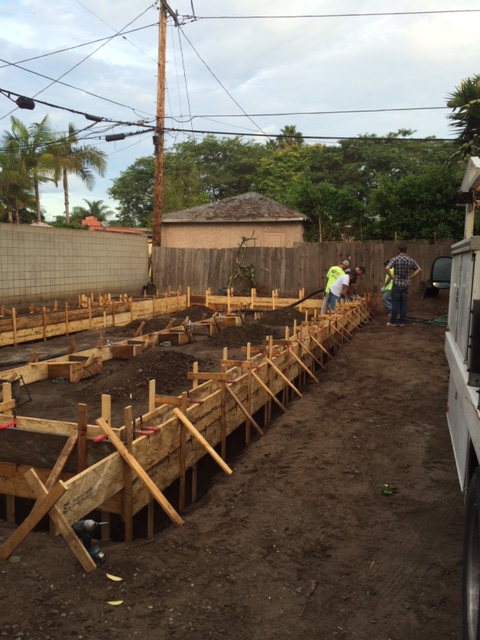
Krumpak: It’s changed. It’s taken twenty years—more than twenty—for it to kind of wake up. When I moved in, there were people across the driveway selling drugs on their back patio every night. There was a pool hall down at the corner that was another dealing spot, every day and every night.
That’s all gone now. When I moved in, we were the youngest people in the neighborhood. Youngest white people in the neighborhood; it was very Hispanic at that time. It still is, largely, but it has a whole other element now as well. Good or bad. Now, it’s flooded with young people jogging, walking their dogs, hanging out in the cafes. It has definitely flipped over from one way to the other.
It isn’t so much that I have an allegiance to the geographic place, although I have to say, being ten minutes’ bike ride from the beach—we ride bikes a lot—is really important to me. I could never live any farther. Not ever. I would never want to live any farther than ten minutes’ bike ride away from the beach. I grew up on Santa Monica Beach, Venice Beach, my teenage years were there. I have fond memories of it. Both my boys are surfers and musicians; you know them. They grew up on that beach, so that’s another generational thing passed on, the beach that Jan was born next to. We have lots of memory banks of that particular geographic location that go back through both of our families, and through the lives of our children. They continue to use that history. As I said, they just…both of them could not live far from the beach. They just need it. It’s in their DNA. If they’re not in the water, both of them, they’re unbearable [laughs].
I have my studio there [in the original house], which we are redoing now, and we have the band’s rehearsal space that adjoins my studio, so we have young musicians flowing in and out all the time. They’ve become part of our extended family. They sit around our kitchen table drinking a glass of wine, having a beer, talking. I hear about their escapades. One of them works and travels around the world with Dave Foster, setting the stage for Stevie Wonder, and things like that.
I get to hear all about that stuff. I hear music from them practicing while I’m painting in the studio. I listen to their CDs or their working tapes from recording sessions…that, plus other music. They’re always bringing music to me, loading my iPod. You know, my youngest son, Miles, is a completely esoteric jazzophile, besides being a rock drummer, so, he’s actually playing in that studio six hours a day. On those set of drums, playing.
That house was owned by my eclectic uncle. The house we live in now was designed by Jan. And the new building that we’re building was designed by her as well. How many people, working-class people, can say that they live in a house? That they live in a neighborhood that has personal history, in a building that one of them designed? Next to a room where your son’s band practices?
Bach: It’s pretty remarkable.

Krumpak: Our immediate place is very, very, very important to us. It props up that whole idea of an integrated approach to art-making and teaching. The relationship of being the artist to the making of the product is all propped up by that.
Bach: Sometimes quite literally. I remember…I’m not sure about the paintings that you’re doing now, but there was a series a while back where you were asking architects and painters and creative people, “Let me have access to your studio, let me have the scraps, let me have the little castoffs, the objects that are in your studio. If you’ve done some construction, I want the spare wood.” Those ephemera became the literal shapes that you would put down and trace around, and they became these reoccurring motifs. So you were bringing your connection with…I can’t remember his name, the architect.
Krumpak: Michael Folonis.
Bach: Folonis. Bringing stuff from his studio into the painting.
Krumpak: Yep, his blueprints. Everything.

Bach: Your relationship to not only your immediate place, but your connections to your friends and their places, becomes a direct connection in the work and how you make the work itself.
Krumpak: Absolutely direct. Totally direct. Phil [Mantione] and Alysse [Stepanian], who we both know, composers, videographers…the plans for their house in New York, in upstate Delaware actually, I guess it was. Their whole plot plan, and those all became actual shapes and forms within a work. For a while, you’re right, I would be working with architects who were doing projects, and I would be using the verbatim plans, overlapping them to create geometric forms or compositions based on real architecture. That was really important, that it be a real place and real architecture. Nothing in the show that I have up now, for instance, no matter how many patterns are in them or pieces of geometric juxtaposition of forms, there’s not one single thing in any of the work that is made up. Even in the large painting, little floating teeny inch-high silhouettes are tracings out of a catalog my father used to order hardware for his store. The color, sometimes, is an indigenous palette to a particular place. Sometimes, the color runs free, and is just an expressive choice. But, the actual composition within the work is never made up. I like that concreteness of attachment that you’re talking about.

Bach: For the casual viewer, he or she might see something recognizable, like a familiar shape or interesting juxtapositions of triangles and rectangles in an interesting way, and maybe there’s an architectonic feel to it. But, for the people who know you, and specifically the people whose material you’re drawing upon, it’s like, “Ah. That was interesting how you transformed that…”
Krumpak: Yeah, they have an inside track to it. I ask people who look at the work, “How much do you want to know about the work? Because I can tell you a little, I can tell you medium, or I can tell you a lot. How much time do you have?”
Bach: “And, do you want that kind of relationship to the work, or do you just want to have your own…”
Krumpak: Yeah, exactly. Exactly. I don’t impress that or don’t load it on it. Almost always, when they say they do want to understand something beyond the visuality of it, they say, “Ah, that’s great!” Not that I’ve chosen something great or that I’m great, but that it’s so much more fun for them to actually look at the work now that they understand all the different sort of things that have been ciphered down to create that particular work of art. That it’s reaching from all these different places, or a single site. That information really does seem to bump up their enjoyment of looking at the work. I love that.
Bach: There’s a simultaneity and a complexity going on in the work, because there’s this relationship of the shapes having this very real connection and purpose. There’s this connection to your relationship with the people and the place, but at the same time, it’s a painting. The painting takes a long time to make, sometimes a year, maybe longer. There’s the act of labor in the studio, night after night, weekend after weekend, this slow progress, seeing the painting slowly take shape over the course of a long time. A painting is a painting. But, it’s also this relationship to your friends and to these places, and it’s also this conversation that you’re having with the process of painting. So there’s this complexity and simultaneity going on, that you as a painter are making a physical painting. It’s ‘abstract painting,’ but it’s not abstract. It’s this, and it’s also this.
Krumpak: Yes, yes. That’s exactly right.
Bach: And, it’s also the music that’s playing. It’s also the wine that you’ve had that night. It’s all of it.
Krumpak: Yes, right. Thanks for saying that. That’s the idea. The process of making these paintings for the last eight years, these very slow, ‘they take as long as they take’ kind of paintings, is to allow…well, you know this. When you have a real span of time, say a year, a lot of life happens in that year. It invites that intervention in there, right? The process, by its nature, painting slowly and meticulously with very teeny brushes on big, sometimes very big canvases, allows there to be a lot of conditions that can subtly alter the result of the work. Who knows what makes you choose this color or that color. I know that there’s a level of finish that I’m looking for that is needed to house and compress that stuff you were talking about into a viable thing called a painting. Then, there’s the stuff that happens in life, moment to moment, day to day. Circumstances that help you make subconscious choices. Things like the color, or the amount of layers of paint that should be on this part of the painting, or on all of the painting. That’s the decision. You have an aesthetic goal for the quality level in terms of visuality, the way the edges meet, how consistent the surfaces should be so that there’s a democracy across the surface. That speaks to the connectedness of all aspects, because they’re all painted with exactly the same amount of paint. The edges are all the same. Sort of a Cézannesque way of thinking about the democracy of a surface. That applies then, philosophically, to the democracy of the information that goes into making the painting. That’s something I’m very interested in.

But, I had to slow down. A lot of the earlier work was about setting up intentional conflict to increase drama within the work. Whether it was color conflict or source information conflict, geometry versus gestural mark-making, it was all to set up a change of pace, quickened moments and quiet moments. It was an antagonistic situation, a yin and a yang, that I was interested in housing in a work to make a certain kind of ‘rocking’ quality. When I started this work, about seven, eight years ago, I asked, “Can a painting be successful without internal conflict? Can it ride on a multi-layered, complex discourse, a median conversational level, and be successful? Or, does it need those things which are easier to rely on?” Black against white, red against green. Sharp against diffuse. Those are ways that people have always created dynamics. But, what if you let that go? Will it become boring, or will it become more subtle, and perhaps have the ability to house more?
That’s what I’ve been trying to do. That was a big shift in my work. The work is about a connection between Japanese domestic architecture, where intimate things happen, and mid-century modernist architecture, which was post-World War II. I was born in 1949, so, that’s me, and that’s the kind of house I was living in, that I am working in now, soon to be changed.
Again, there’s the multi-level connection that I’m drawn to. How can I take those two aesthetic positions in architecture…what do those pieces of architecture mean? When they’re fused together…because they look ‘Pacific Rim,’ and they’ve somehow influenced each other. You start pushing those philosophies of real architecture and space that is lived in. That’s important to me. It’s not commercial space; it’s lived-in space. When you join those forces together and let them…what does that do? It’s about cadence and rhythm, and about a poetic locking and unlocking, hopefully. It’s about setting up a kinetic thing, which is not about loudness. It’s much more about…there’s this thing in Japanese garden landscape, right, which is to allow things to be what they are, but use them.
That’s what the work has come out of. How do I take these things that come from these components, and then lace in literature and poetry and song lyrics and things like that that are also close to me? How can I make them come together within the work to make distinct, different paintings, so that they don’t all look alike, and let them be what they are but hang out together? That’s what’s run this work. That was a big shift for me.
Bach: And, I think it’s probably connected to the work that you’ve done on the house over the years, and living in a place that’s had disruptions. Right? You haven’t had a domestic situation where everything stayed the same, everything was already set. You were always tinkering with the structure, and building the new house, and then changing the new house, and trying to get the city to sign off on the studio and the wall and the…all that stuff has been, for better or for worse, in flux.
Krumpak: Yeah, it has. It has. For a long time.
Bach: The boys, growing up, graduating, moving on.
Krumpak: Coming back.
Bach: Coming back. All that, I think…whether that informed the shift in your work or it coincided with the shift in your work…
Krumpak: Interesting.
Bach: Or the shift in your work influenced the…
Krumpak: It’s in relation to that shifting chaos, or whatever you want to call it. Yeah, that might be. Who knows? That is an interesting notion, too, in another way. I think when I left San Francisco…that whole thing changed when I came to L.A. I never got back to being…in San Francisco, it’s a city of domesticity. It’s an interior city, gets cold a lot, it’s foggy, it’s atmospheric. You sit in places. You read books. Ferlinghetti’s bookstore, City Lights, all that stuff. When I came to L.A., I don’t think my life ever went back to domesticity. We do very domestic things. We raise children, and eat dinner together…but, I never believed in it anymore. I never believed in it anymore. I never desired…I desire some sense of order. I enjoy things being in their place. It just doesn’t happen very often. But, I don’t believe that everything in its place means I’m OK, or it’s a signal that I have…
Bach: Matured.
Krumpak: I’ve matured, or that I understand I’m an intellectual, or that we are a good family. Those things never came back together. I had my dose in San Francisco, and that was over. I think L.A. is like that. It’s shifting, and it’s wide open. Sure, there are a lot of things that are happening that make it about apartheid, economic apartheid, and we all know that. But it’s a horizontal place. Things slide all over the place. San Francisco has a vertical pecking order. You understand your place and you hone it, buddy.
New York is a city of learning rules, right? You learn how to sit on a subway car, how not to look at other people’s faces. You learn how much personal space to take, or not. You learn what pace to walk on the street. You have to learn a lot of rules to just wake up and go to sleep in New York City. And then, you pride yourself in doing them well. That’s what a New Yorker is.
But in L.A., for me, it’s a horizontal, non-domestic situation. I never tried to internalize that in my close-in space. But I do bring that kind of working…I like your analogy. It’s like a ‘working man’ kind of process to making paintings. You go in the studio, and you work. You work for as long as you can, and then you shut off the lights, and you shut off the music, and you leave. The next day, you come back and turn it all on, start the music, drink that coffee, and start again. I think it can feel very genuine and very comforting. At the same time, it feels like a racket and discipline, and it feels like, “Oh my God, I can’t believe I’m going to sit in there and work, stand up for six more hours with a teeny brush in my hand.” But, there’s a love for that, too. You start the painting, you ‘middle’ the painting, and you complete the painting. Go to work. I’ve never shied away from work. Neither did my father or my mother or my wife. We are a working family.

Bach: Right. And now, you have two sculptures in the show. You may have done sculpture before, but I’ve never seen any sculpture from you. The two pieces, in the time that I’ve been able to spend with them at the opening, are very intimate. Very personal and playful and rich and complex, but not fussy. It’s just this celebration of interesting, cool, meaningful stuff. “Here it is, I’ve put it together in this sort of compartment that you have to…”
Krumpak: It’s a place.
Bach: Yeah. It’s like a closet of curiosities that you’re seeing some of it, but there’s other stuff that you can’t see. That has come…
Krumpak: Relatively new. Yeah. When I was in San Francisco—and I was very, very, very young—I made sculpture like what we now call ‘pathetic.’ Provisional. It was very not sculpture. I made it out of birds’ feathers from my own bird, you know, and bead work that an Indian woman showed me how to do, and I would collect. I made sculptures and three-dimensional objects out of rhinestones, and by buying glittery fabric and sewing it and stuffing it like a pillow and putting rhinestones on it and mounting it on the wall by pins. Very not traditional…they were like objects of oddity and seduction, you know, because I didn’t know how to do sculpture. So these are, in a way, related to that. They’re not obvious, traditional sculptures.
Bach: And I don’t think of them as sculptures. I think of them, in a way, as three-dimensional paintings without a whole lot of paint in them.
Krumpak: Right. That’s right.
Bach: It’s the stuff that normally would be traced and made into a painting, but, now, it’s just the object, and it’s just a different arrangement of it.

Krumpak: Right, yeah. I think that’s right, and I like that, actually. Thank you for saying that. The idea of tracing is that, as you just said, you take the object and you stick it down and you draw around it and then you paint it in. I don’t paint it illusionistically, I leave it flat, with the trace.
Bach: Yeah, the shape.
Krumpak: Yeah. Now, the idea is to just move the object out, take it out of the closet, and just let it be what it is. That gets back to that Japanese landscape idea. Let it be what it is, but, put it in a context that makes it more than what it is, or at least contextualizes it and opens up new possibilities for what it is. Keep moving it around, just like you would with anything, painting or your music or whatever, until it doesn’t want to go anywhere else. Then, that becomes its position in the piece. The damnedest thing in making those sculptures is, when you start making that kind of sculpture, with found objects and handmade things that you make, and you ‘collaborate’ them together…as soon as I start making these three-dimensional things, everything…
Bach: [laughs] Yeah.
Krumpak: …in the world, every single thing that I walked past, I was thinking, “Well, gee, I could use that. I could put that in there.” And, I was doing that in the studio. I put podiums in the studio, and I’d just start throwing stuff on them, pulling stuff off, and screwing things together, and then taking them apart and attaching something else. And I realized, wow, man, anything…you can just do anything.
Bach: I just thought of the way you would make the still lives in the drawing classes and painting classes. You’re describing exactly what you would do when you would build a still life for the first time. You would put stuff on there, and take stuff off, and put it there, and let it sit for a while, and choose something else. It’s that same spirit.
Krumpak: Exactly. It’s training for it. I thought of that when I was making them. I thought, “I don’t know anything about making sculpture.” I honestly had no criteria. “Don’t fake it; I don’t have any.” But, then I thought, “I’ve made still lives for years, and this is like making a still life,” so, I totally agree with you on that. Once I got that, that this is a place, it’s a location, it’s a still life that I’m making, and I’m making it out of stuff that I’ve been saving for God knows why…so, I’m going to put it together.
Bach: And who cares?
Krumpak: And who cares? I’m going to put it on a pedestal, and then people can come and see it, and…great. I don’t have any defense about it. I’m not protecting it at all. I don’t think it about that way. It animates the exhibition it’s in, and it offers another opportunity for a dialogue between the paintings and the three-dimensional objects. The flatness of the painting and the dimensionality of the objects, and that is just a nice conversation to have happening in the room.
I think another thing that, when I was making them, I was thinking about Matisse, and I was thinking about Matisse’s hotel rooms that he would decorate, and the way that he would hang patterned fabric, and have the odalisque sprawl out in front of it or sit in a chair in front of the window, and have pattern on pattern. Just the joy of the Persian harem tent in a hotel room that was cheap, and what a wonderful fakery that was. So I thought, “This is like that. I should just enjoy decorating and that logic.” And, when he says that “decoration is expression,” I thought, “Yes, I am expressing myself creatively here.”

A wonderful assemblage sculptor I know, who’s also a friend through jazz, we’re both jazz fiends. He’s a sculptor, makes wonderful assemblage and one-of-a-kind standalone sculptures, and is a painter. We’d see each other at jazz things, and I’d say, “Oh, God, I don’t know what’s going on! I have no idea what I’m doing!” And he would say, “Tom, yes you do. Just calm down. Just think, ‘I am creative, and whatever I make, therefore, will be OK.'” You know, that’s easier said than done. But, he was really wonderful. He just was so sweet, that it made me think, “OK, I’ll just do this thing.” And, I had a deadline for the first sculpture, so I had to hit that deadline.
Bach: To get it photographed?
Krumpak: No, to go on exhibition in downtown L.A. It toured for a year of locations in downtown L.A., the one with all the stuff and junk on it. Then the other one, my deadline was for this exhibition. I knew there was a finish line, and I knew I had to get them done, and I knew I could mess around for only so long and live in indecision, and then I had to start making some decisions: “OK, this form is basically OK, and I can change these things,” or, “This is staying, and so I’ve got to find something that’s more compatible than what I have.”
Bach: Right. And, you know, the work is never completely ever finished, right? We’ve talked about this in painting classes. It’s like, a painting or drawing or a piece achieves an equilibrium. It achieves a sort of plateau that, OK, I guess if you stop now, you could call it done. If you add something else, then it upsets that equilibrium, and you then have to go in and go further. So, you came to this point where you had to let it rest in equilibrium. It may not be done the way you thought it was going to be when you started it, but who cares? It is what it is, and…
Krumpak: Yeah, and let it be. Let it be. Make sure, like you would with any kind of musical composition that you’re writing…I mean, you have a criteria level that you’re looking for to feel justifiable for somebody to witness it, right? Somebody other than you. So, you have to bring it to that level, where you feel this experience would be at least worth it for somebody to encounter this thing. Then, once you feel that’s OK, you can just let it be.
And, you know how it is. Well, it’s different in music, certainly, than in visual object-making, but things exist in their time. As soon as you finish them, they start disintegrating. They just do. Paintings gets old, the paint gets crusty. Rust stains appear on the back of the canvas. What I liked about these assemblage sculptures is that I had to assemble parts of them on location. Some parts are welded together. But, then I had to open the drawers and stuff the drawers with things, and take stuff out of the drawers if I had to move it to another location, or put it in storage, or whatever. In the meantime, life can happen, and you say, “Oh man, this would be great in the drawer instead of that.”
So, every time this sculpture would travel from one location to another over the year, downtown, and before it went here, I switched things up. It didn’t have any static state, just the basic format stayed the same. Or, I had the box sculpture, and I had to take the drawers out from the utility boxes, put them on the base that I made. Then, I had to open the other boxes. “How much should I open the door? This way or this way?” There’s no right way. Each time I can modify it, or take the scroll out of it and put another one in there. I’m not going to let anybody see them anyhow, so they’ll never know, but I will. That’s part of dealing with the inevitability of…things do reach a peak, and then they start falling apart. But, you can have fun playing with that reality.
Bach: There’s a freedom, and a sort of lightness. Not that I’m saying your paintings are heavy, but that there’s a lightness to that process in the sculptures, whereas in the paintings, you put a shape down, and you paint it, and you put the next shape down. You’re putting these shapes down in these relationships, and once the painting gets to where it’s done, you’re not about to go in and sand all the stuff off and put another…it becomes done and you move on, right? There’s a limited amount of adjustability and flexibility in how the painting can function, right? But with these sculptures, these assemblages, whatever they are, there’s a playfulness to them that could be a whole new…
Krumpak: Yeah. It leaves the circuit open. After Fran [Siegel] went to see the show, she sent me an email, and she said, “Oh, the show looked great, but the sculpture,” she said, “those are the closest thing to your interest in jazz of anything you’ve ever done. Because they are so jazz-like, because there’s a sense of playfulness and immediacy to them, yet there’s structure behind it, and there’s also this thing of creating a kind of poetic juxtaposition of things.”
Bach: That’s different every time.
Krumpak: And it can be different every time, but it’s the same core or spine.
Bach: Which is jazz. Taking a standard or whatever, and the improvisation that happens upon that structure. Any performance is going to be slightly…
Krumpak: Yeah, exactly. I thought that was really interesting. She’s very smart, so for me that was very insightful, like, “OK, I don’t play in a rock and roll group anymore, but I’m still making music” [laughs]. So, maybe this is a way of doing that.

My conversation with sound artist and educator Steve Barsotti is now online at Imprintable.
Steve Barsotti is a sound artist and educator based in Seattle, Washington. This conversation took place over Skype on 10 September 2013. Originally imagined as the groundwork for a potential collaboration under the Atlas Sets project, the interview fits well under the Imprintable umbrella. Note: the term ‘phonography’ refers to the act of recording, collecting, and performing sounds by a diverse community of sound artists, composers, acoustic ecologists, and other audio-centric practitioners.
Glenn Bach: So, what’s going on right now? The [Seattle] Phonographers Union have a new disc coming out?
Steve Barsotti: We have an LP coming out [the LP is available on Bandcamp–GB].

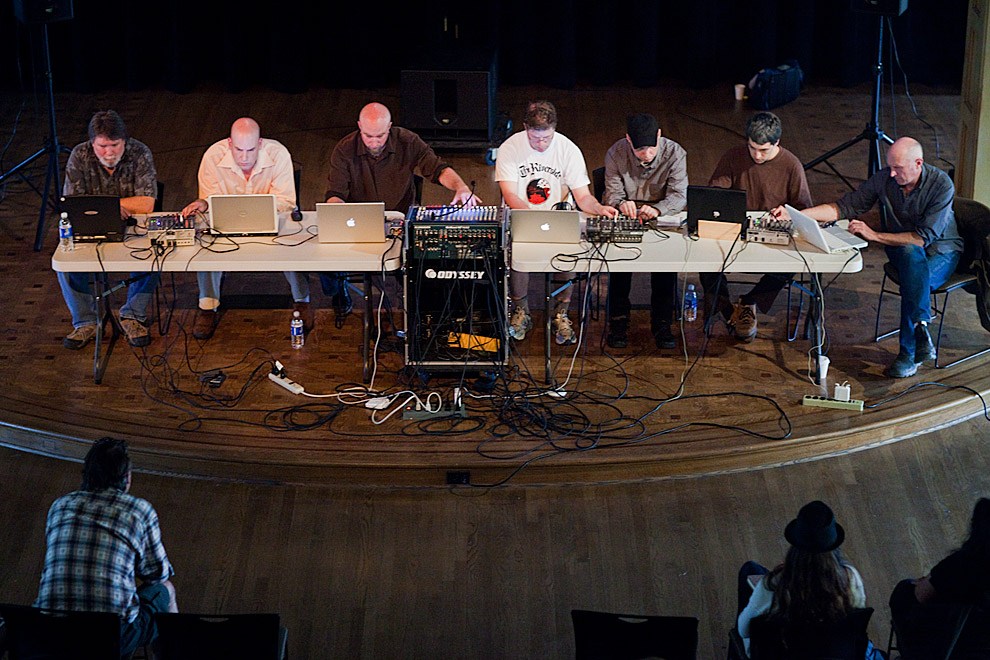
We performed in this aircraft hangar in a park in Seattle called Magnuson Park, which used to be a Navy base way back, so there are a lot of hangars on this site that are being redeveloped for commercial interests. The building that we were in, Building 23, is now an indoor sports arena, so there’s a lot of that kind of stuff happening. We went in with a sound system, and we played in this huge, huge cavernous space. We took our typical setup, which Chris DeLaurenti dubbed the Politburo…
Bach: [laughs]

Barsotti: Yeah, eight of us on a platform with laptops and lights on our faces, overseeing the audience. We adapted that form in this incredible space. We performed there two times over the span of three or four years. I recorded both of them, in surround sound and in stereo, but the second one had a more consistent feel. Chris and I took that section and mastered it, and it ended up being our first CD, along with a collection of excerpts from five or six different shows.
We got a residency through this organization called Environmental Aesthetics, and they had access to this nuclear silo down in Elma, Washington. It was to be the largest nuclear plant in the country [Satsop], but it went grossly over-budget in the mid-seventies. They finally shut down the project, but they had already built the two huge cooling towers. No nuclear material was ever installed, and now it’s an industrial park, with different types of businesses. These towers have amazingly unique acoustic signatures. A variety of people have gone in there to do different things.
We went down there with a sound setup, and four of us as the Phonographers Union did a two- to three-hour set inside this tower. So, Side 1 of the LP is going to be eighteen minutes from Sand Point, and Side 2 will be eighteen minutes from Satsop. I selected the excerpts, mixed them, and mastered them. I took them to an old-school mastering engineer in town named Ross Nyberg. I met him through the Art Institute [Steve was the Academic Director of Audio Design Technology at the Art Institute of Seattle–GB]. One of the cool things about that gig is that I’ve met some cool professionals.
Bach: Definitely.
Barsotti: So, Ross mastered the LP, and this guy knows what he’s doing. He has an amazing setup. I went out to his studio in Issaquah, and, he just went through and helped me pull out nuances that sound great. It should be out in November. I put the last final touches on the artwork and text yesterday, as a matter of fact, so I’m looking forward to it.
Bach: What label?
Barsotti: Prefecture, from Paul Kikuchi. It’s an independent label, primarily his own stuff, but expanding into some other things. For me, what he’s doing is like the newer school of labels. There is the typical label, which we all know—and love, depending on whether they release you or not. And then there is the individual who calls himself a label in order to get stuff out.
Bach: Right, right.
Barsotti: More and more, there are these hybrid collectives of people, where artists are getting together to release stuff. They really do look, smell, and taste like labels, but they don’t necessarily use the same business model or structure. Paul started Prefecture in order to release his own stuff, but he now has other artists. The SPU is footing the bill for some of the pressing; it’s a shared responsibility on a lower scale. If we’re talking about community, the smaller labels are doing this stuff, where there is a shared responsibility among the people involved.
Bach: So, what’s the run on the LP?
Barsotti: 250? We also just released a cassette through Banned Production. Anthony King. He’s down your way, actually, in Los Angeles. He just released a 50-run cassette with ten minutes per side.

We did a couple of sets on KUOW, the local public radio station, in the midst of these hour-long discussions about phonography as part of the Sounds of Winter, Sounds of Summer series.
Bach: I remember those.
Barsotti: We did quick five-minute sets. I put two of them on Side 1. On the second side is an eleven-minute excerpt from our very first performance in 2003 at the Indy Media Gallery, the first time we ever got together and did this as a group. It sounds great. The work is good. I’m still looking for the power cord for my cassette deck.
Bach: [laughs]. Yeah. So, the phonography thing has gone through some iterations over the years, hasn’t it? I remember when I first heard the term, in the context of phonography.org, the website and the listserv, which is still going.
Barsotti: With these things, there’s a small group who starts them, with conversations that are pertinent to that group. Then other people join, and, to be fair, it evolves over time, maybe not to the agreement of the people who started it, but that’s what you get for letting more people in. That’s what happens.
Bach: Yeah, it’s not like a secret cult or anything. It’s not like we have the corner on the market of recording sounds from the real world. People have been doing that for a long time. It’s not a closed system where only we have permission or the authority to go out and do that. It parallels the idea of the bedroom laptop producer; if everyone has access to cheap software, is everyone a producer? If anyone can go out and record sounds, are all of them phonographers? It really gets down to your state of mind or your intentions.
Barsotti: This isn’t necessarily a push for agreeing with this, but any art movement where you create a beginning, an end, a set of parameters, conditions, or descriptions…there is a difference between the Impressionists and the Surrealists because of their different approaches. I’m not suggesting we’re in the middle of a Phonographerists period. I don’t know if this is a good or bad thing. The phonography.org list started out as an idea of sharing a similar way of thinking about that subject, then you start bringing in all these other people…and, like you said, just because someone goes out and records does that make that person a phonographer? Well, what is the definition of a phonographer? Do we want to commit to one?
When I first moved to Seattle, there was a collective called The SoniCabal. This was in 1999, 2000, 2001. It was a group of sound artists and experimental musicians and people doing all kinds of crazy things with music and sound. Some of them a little more conventional or traditional. Others a lot less so. They had already released one compilation, and I was part of the second compilation. We did it collectively. We divided the CD into 74 minute increments, and you paid per minute.
Bach: Okay. Interesting.
Barsotti: If I had five minutes of material, I paid for five minutes of time. It worked. And I also got that percentage of CDs. There was also an e-mail list, and a weekly or monthly meeting where we had the opportunity to talk about what we were doing, listen to others who had something to say, and listen to work. It was engaging. And over the course of five or six years, the group shifted. There was an element that started coming to the meetings and participating in the conversations that ended up basically taking over. And they happened to be a little more…are you familiar with the Decibel Festival here in Seattle?
Bach: Yes.
Barsotti: Some of the early crowd from that group started taking over the SoniCabal, and defining themselves as the SoniCabal. And, I don’t think I really cared, since I had stopped participating…but there were definitely those who were resentful of this newer crowd taking over this collective and redefining it. Based on what they had written about it, the SoniCabal was specifically meant to be open and defined by the people participating in it. And the people participating at that time happened to be more beat-oriented, more involved in electronic music, and less into concrete music. Phonography was still being figured out as a term at that point.
I think a similar thing happened with the phonography.org list, and it happens often: you have an idea or concept, and you create a structure around it, and you want it to be democratic and open, because we’re liberal and that’s what we think is right…
Bach: Yeah.
Barsotti: And then it changes.
Bach: Right, because that’s what happens when you open it up. When you don’t enforce membership. If, like SoniCabal, the membership is what the members say it is, then the current membership has a say in what it is. And if you suddenly find yourself in the minority, you have to be okay with the floor shifting beneath you.
Barsotti: It’s like the Surrealists, and the Dadaists. And Fluxus especially; they were weird, because they had this dichotomy of breaking open this notion of the art event and the art object on the one hand, and on the other hand, a very strict sense of rules. I took a Fluxus class when I was in school, and we re-realized some of the Fluxus performances. We had to pick from the book of existing works. I suggested that we create new performances in the spirit of Fluxus, but that wasn’t allowed.
Bach: [laughs] Yeah.
Barsotti: These organizations, the people in charge of Fluxus and the Surrealists, said, “if you’re not these things, you’re not in this group, man. You can’t be a Surrealist unless you have weird dreams and paint them,” or whatever the case may be. It’s an interesting notion. And, like I said, I don’t think I am interested in creating a definitive notion of what phonography means, and ensuring that people stick to that. People are writing about it a lot more often now. People are writing about phonography and acoustic ecology and sound, and they want to come up with a theoretical diatribe that becomes the definition of something, because then it gets lodged in the history books. And some people are doing it, some of whom we know, and we see them on Facebook. They’re articulate and academic and they’re writing these things. It’s fun, but, to me, it’s just weird.
Bach: How much of what you do would you consider phonography-related? I would never call myself a phonographer because that’s such a small part of what I do, and even when I practice phonography, I’m not a purist.
Barsotti: Right.
Bach: I don’t use high-end gear to record pristine recordings, and I don’t know if that’s punk rock of me, or DIY, or just lazy. Field recording is simply part of this larger, integrated thing that I do. Can we even talk about these isolated communities anymore? “I am a phonographer.” “I am a poet.” “I’m a this, or a that.” The boundaries between these groups seem so porous now that I’m not sure I can claim membership in such a narrowly defined group.
Barsotti: Well, I have an easy out. I’m in the band, man.
Bach: [laughs] Right, right.
Barsotti: So, I started this term at Cornish [College of the Arts], and, as we all do on the first day of class, I introduced myself, and I found myself marveling at the list of descriptors that I sometimes come up with: improviser, phonographer, composer, sound artist, educator, whatever. It’s in my bio. Sometimes I use those terms to give context. Do I consider myself a phonographer? I’m not entirely clear what a phonographer actually is.
Bach: Right.
Barsotti: As part of the Seattle Phonographers Union, it’s easier for me to use that term because of the idea of the Phonographers Union. We’re not the genesis of this concept, by any means. We’re a realization of an aspect of that concept. We’re a possibility of what that concept can mean. What’s interesting is that each of the members of this group, over the years, has come at it from very different places. Perri [Howard, nee Lynch] is a sculptor; she has public works all over the city. So, there are a lot of different perspectives, which is one of the most fascinating things about this group. We’ve been together since 2003…ten years, our tenth anniversary.
Bach: That’s crazy.
Barsotti: It is crazy. So, hopefully this album will be the grand ten-year…
Bach: That’s fantastic. Perfect timing.
Barsotti. We’ve [SPU] never had a discussion about what phonography is. We’ve never had a discussion about what the rules actually are. We’ve hid behind the general statement, “We improvise, in real time, with unprocessed field recordings.” That’s all we’ve ever said. There seems to be a general acknowledgment, because we’ve said it out loud, that contact microphones, magnetic coil microphones, hydrophones and things like that are allowed, but we’ve never sat down and said, “What is phonography?” Because I think we’d break up if we did [laughs].
Bach: Right.
Barsotti: Because we’d never agree on anything.
Bach: Exactly. And what fun would that be?
Barsotti: Yeah, I know.
Bach: Trying to control that.
Barsotti: We’ll all get rip-roaring drunk and have a conversation about what phonography is and never speak to each other again.
Bach: It’s funny, because I used SPU as inspiration when I was in Wisconsin to start Milwaukee Phonography. It didn’t last long, since I was only there for two years. And, then with the Southern California Soundscape Ensemble, participation and membership waxes and wanes with the collective energy level, but it’s still on the books. The same concept underpinning both of those projects is exactly what you just said: we perform live with mostly unprocessed field recordings. And I use the term “unprocessed” loosely.
Aaron Ximm joined us in Milwaukee, and he used loops. Is looping forbidden? Some people are working with cassettes, Dictaphone tapes, and maybe the pitch is a little different; is that okay? I’m not about to tell people, “No, you can’t do this.” With the exception of obvious processing, like effects or reverb, I think the aim is mostly unaltered recordings. It’s great, because that construct isn’t a limitation at all. It’s actually an open and freeing concept.
Barsotti: It’s funny, because I’ve run into people who initially say, “I don’t understand…you can’t use any processing? Doesn’t that limit you?” Well, no, quite frankly it frees me because I no longer have to be concerned about what processing I’m going to use, or how much flange, or how long the reverb tail should be, or any of that. And I also counter with “it’s not that I don’t enjoy the sound of a good LFO, it’s that I also enjoy the sound of a cricket.”
Bach: By itself.
Barsotti: Yes. I have this electronic music class I’m teaching, and this week is musique concrète. And we listened to a couple of pieces by Pierre Schaeffer, of course, and they’re interesting and difficult for the students because they are immediately dated by the sonic quality. But then there is Luc Ferrari‘s work. Music Promenade, for example, is a gorgeous musique concrète album. And then there is all of Dale Lloyd‘s and/OAR catalog: field recordings, some of it processed, some of it not. There’s so much there. It’s so rich and so wonderful and so beautiful to listen to. It doesn’t mean that I don’t like that other stuff. I just don’t feel the need to do that all the time.
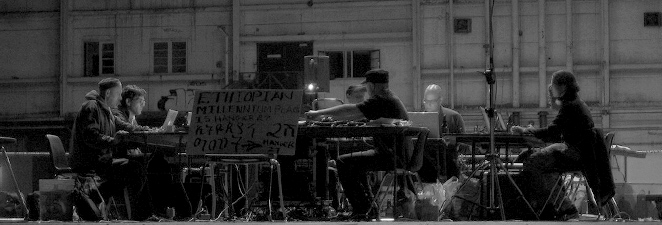
Bach: There’s a time and place for that other stuff. And this [SPU] is the time and place for sounds from the real world. Just let them be what they are. They are musical enough, you put them in different contexts and your collaborators will bring in sounds that you would have never expected, and that’s a remarkable aspect of group improvisation. One of the most exciting things I’ve done in a long time is working with the Soundscape Ensemble because it’s unpredictable, fresh, fun. It tends to not be overpowering in density.
Barsotti: It’s an amazing exercise in restraint to perform in that environment.
Bach: With SCSE, we have two “rules”: unprocessed field recordings, and each person has to have his or her own individual amplification. Since we spread out throughout the space, the audience hears sounds being broadcast from all directions. That’s our mission, and, like you said, it’s this perfect recipe for restraint, because each performer has to listen and pay attention out of necessity, and it does wonders for the group. We can have six or eight people and it sounds balanced. It’s my favorite group improv project.
Barsotti: How many times have you been to a performance where you never really know how it came off, because you were not in the audience? You’re so in the midst of doing your stuff, you get a very different perspective. So, our sets…of course, they vary, thirty minutes, an hour…the stuff we did at Sand Point was four or five hours, over the long haul. But even with the shorter sets, there have been multiple shows where I can say I performed for ten minutes. It is the only performance where I can come back later and say, “I heard the whole damn thing.”
Bach: Exactly.
Barsotti: It’s about trust and restraint. This gets into the improvisational aspect of this. Improvisation, for me, is about listening. And, I think about the concept of improvisation as a metaphor for how one ought to interact with the larger world, not just musically, but socially, culturally.
Bach: Yes.
Barsotti. When Dan Godston started the World Listening Project, and he came up with concepts of what it meant and what it meant for us, I wanted to push the notion of listening as a political act. Where, instead of imposing your beliefs or ideas on other people, you listen to who they are. Take in information in order to learn and grow. Improvisation, musically, for me, has always been about that. It becomes a metaphor. It’s not been perfect for me. I’ve had shows where I’ve performed for five or ten minutes, and others where I performed the entire time, and I look back and think, “Wow, I bogarted that one, didn’t I?”
Bach: Right.
Barsotti: I’m trying to take that into account with my improvisation. In fact, I just read a quote recently from some stupid internet meme: “Listen with the intent of learning rather than the intent of saying something,” or something along those lines. So, for me the Phonographers Union has always been a wonderful opportunity to do that very thing, and it’s a wonderful experience to listen and to really find out if you really should be contributing, or that what you have to contribute really works.
Bach: Yes. To avoid selfish playing.
Barsotti: Self-aggrandizing.
Bach: Simply wanting attention. And I think that’s a perfect way of saying it. “Is the sound I’m about to play a positive addition to what’s already happening? If what we’re hearing is already perfect, then let it be perfect and just sit there and enjoy it.” So, with SCSE, there is an opportunity to be simultaneously performer and audience.
Barsotti: Indeed.
Bach: A lot of times in other improv settings, you’re so focused on what you’re doing that you lose touch with that. With the phonography setting, there are moments when I played only one file during the entire performance; I would bring it up at times, then bring it back out, and there were moments when there was open space, and I chose not to bring it back in, because it wouldn’t have added anything to the perfection and the beauty and delicacy of that moment.
And this is what I’m talking about when I talk about community, when we can find people who are open to that as well, and can appreciate that openness without being forced. That’s a blessing, right? To perform with people who are already there. You don’t have to twist their arms and say, “Let’s be quiet.” It’s such a rare thing.
I had a performance a while back that was the complete opposite of that. And it left such a bad taste in my mouth because it was so dense and so impenetrable that it was really painful. That type of gig is something I said I’d never do again. I’d given that up years ago. I thought it was going to be different, but it wasn’t. When that happens it’s really disappointing, because there’s really no need. It’s walking the talk. When you say you’re going to listen and be open, then do it. Really do it. Shut up for a while and listen and don’t play anything. By not playing anything, you’re still contributing. You’re contributing in silent participation by simply observing and backing out and allowing an absence that can speak just as powerfully as a presence.
I’m really interested in how that comes together naturally, and I don’t know if it’s because of the people I’ve chosen to associate with, or there really is something in the air that we’re all part of? Serendipity? Probably a combination of all of that.
Barsotti: Yes. I think there is definitely something about like-mindedness in terms of the concept of listening. I know that the original impetus for this group was a fellow named Isaac Sterling. Way back in the early days of phonography.org, 1999, 2000, right after I moved here, the phonography.org list got established, people were contributing, conversing on there. And then Isaac realized there were a lot of list members here in Seattle: Alex Keller, John Tulchin, Doug Haire, Mark Griswold, Steve Barsotti, Chris DeLaurenti, Toby Paddock, Dale Lloyd. There was a bunch of us who were interested.
So, he called this meeting. It was Isaac who recognized this particular quality in each of us. He had work from all of us, and he noticed that we were all part of this list and said, “Let’s come together and talk about this concept of phonography and play some work.” And, so, the first set we did was more of an academic presentation of individual work. There were seven or eight of us at the table, round robin, where we each got seven minutes and thirty-seven seconds, if I remember correctly, and we just played. Some of us played individual recordings, and others performed a mix. That was the first set. For the second set we just jammed. It was due to the collective interest we all had in the concept of listening, and Isaac recognized that in the field recordings he heard from us in the first place.
I think in order to work with field recordings, you have to be interested in the concept of listening. You go out in the world and listen to stuff, and there is something about that process that engages you so much that you want to grab it, abstract it, bring it home and listen to it in a very different, strange way. That process right there is fundamental to my interest in this. When I collect a recording, I tend to avoid headphones; I check the levels to see I’m not distorting, but when I bring it back into my studio to see what I have, it’s like the old days of film photography when you’d shoot, shoot, shoot, and then only later look at your negatives.
So, all of these Seattle people had these great field recordings and were obviously interested in this concept of listening. And, they also had these other endeavors. Most of the people in our group have been involved in some level of improvisation. Some, like Mark Griswold, had done work with NPR…he was the sound guy; when the story opened up you’d hear car doors and footsteps on gravel. Toby and Doug and Alex and Chris and myself, we had all improvised and been involved in other music creation. But I recognized that these guys loved to listen. So Isaac brings us together and we do this thing and it worked. I wasn’t surprised, but it was still fabulous to go through that.

Bach: It’s amazing that there was this concentration of all those people in that area. That’s pretty remarkable. That doesn’t always happen. Maybe it was just a convergence, where everyone happened to be there at the same time, and you were hungry for it. You have to wonder, would SPU have come about now? If it didn’t previously exist, would your group come together today and have the same longevity and camaraderie and humbleness and confidence? Could that have happened now, as opposed to ten years ago?
Barsotti: Right. Interesting question. It’s hard to answer that definitively. I look at the nature of our group now and it’s never been appropriate to call us a band.
Bach: No.
Barsotti: For the first three, four, five years there was more of a feeling of a band, more interaction between us, events happened more often. These days there is not as much communication. We still have events, but they’re usually a lot smaller. In our heyday we had twelve people perform at the Decibel Festival in 2007.
These days it’s smaller, different types of gigs. We did a thing for KUOW, and there were one or two members who popped up out of nowhere, “Yeah, I’ll do the radio gig with you guys.” So there’s a little bit of that. As far as your question, I don’t know how to answer that. Isaac passed away a couple of years ago. It was a different time, different collection of people, but the concept has evolved over the years. Back to what you were saying about the setup for your ensemble, the Phonographers Union historically has had the Politburo, but of late there has been more interest in attempts to do what you guys are doing in terms of setting up small locales.
Bach. Yes.
Barsotti: We’ve had some opportunities to perform in some interesting spaces. In Seattle there is a space called The Chapel. In the middle of Wallingford, one of our neighborhoods, there is the Good Shepherd Center, with a preschool and community organizations and things like that, and on the fourth floor there is an actual chapel. It’s a gorgeous space, with huge vaulted ceilings and big stained glass windows. Steve Peters from Nonsequitur set up shop there many years ago when he moved back to Seattle and established the Wayward Music Series. I’d say that 75% of the adventurous music that happens in this town happens in that space.
We performed there a couple of times with local setups, but, more interestingly, we got a gig at the Seattle Art Museum. They do these things called SAM Remix, and, on opening night there are a variety of activities, with a more typical musical setup on the main stage. We got invited to perform for the Aboriginal show. The museum has a small Aboriginal collection in two small rooms, fortunately located way in the back away from the main stage where all the loud stuff happens. Three of us set up in there with individualized sound systems. It was cool because of the way we set up, but it was also cool because it was one of the first times we responded directly to a theme. We as a group asked, “What do we do with an Aboriginal show? What are these paintings about?” They are maps, spirit guides.
Bach: Exactly.
Barsotti: There are these notions of guiding us through something. So we said, “There’s your inspiration, go with that.” We each brought in recordings we felt addressed that concept of what these paintings may be about. That was interesting, but, more to the point, we had been adopting these setups with individualized, small locales, individual p.a. systems, a couple of small speakers, or something like that. And people experience it in a different way. You meander, just like your [SCSE] performances. It’s such a great way to experience that type of thing.
Bach: For me, it was revelatory, because it deconstructed, changed, remixed my whole concept of the group improv. For the longest time a group improv meant going through the same p.a. You had four, six, eight sound artists, using electronics, and unless you’re really careful, you’re likely to get a wall of dense, undifferentiated sound.
So, by parsing this out, it solved all kinds of problems. It solved the soundscape issue, monitoring issues, improvisation issues, and having to lug a p.a. around, right? That inspired me to consider sound in space in a new way. Teaching the audio classes, and researching what I was sharing with students, I was able to wrap my head about the idea of reverb, with the direct sound and the series of copies, and what is called the critical distance, the point at which the direct sound is at the same volume as its reflections. At what point do the reflections take over? What about the natural ambience of the space? The normal sound of whatever space we’re in, along with the sounds we are adding to this preexisting soundscape…at what level do these introduced sounds that are contributing to this hybrid soundscape take over and become louder than the original sounds? It got me thinking about my solo work and about threshold, critical distance, and what happens when sounds are blended together at very low volumes, in a space, through speakers that aren’t necessarily massive p.a. monsters.
Barsotti: Right.
Bach: And, so, it was a transformative experience for me, and it changed everything I do as a performer. I’m really thankful that it happened.
Barsotti: It’s interesting. I really like the idea. I think your method of setting these smaller locale systems allows for a lot more interaction with the ambient space because you’re individualized, you’re localized, and, by default, you have less power.
Bach: Exactly.
Barsotti: And you’re less likely to overpower the situation. That’s fascinating. We’ve always been interested in how our sounds combine with what is already happening. I have no end of examples of shows that have ended with an external sound to the space that becomes our punchline, which is really kind of nice. But, to your point about the p.a. system, the history of our performances have been one massive p.a., and our original concern was the wall of mud, with all this stuff coming through. And that’s what really honed our skills as listeners as far as restraint, even more so as we realize we’re all coming out of the same set of speakers.
Bach: It forces you to be mindful of everyone else.
Barsotti: It was a challenge, but I think that on this album in particular, which is a sort of ‘best of’ collection, we made it work. It’s been a really good run for us as far as making that format really successful. The LP that’s coming out, the Sand Point gig and the Satsop, the hangar and the nuclear silo…now, there’s a whole other concept of space involved in those two pieces, but we’re still coming out of a single p.a. system.

Bach: Yeah. You know, it’s part of what makes it experimental music. My friend Alan [Nakagawa] and I had a conversation about experimental music and what that term means, the idea of the experiment. You establish a hypothesis, you think this is going to happen, set up the parameters, run the experiment, test the results to determine if it was a success or not. So the experimental part of experimental music could be what you’re doing with the single p.a., with six, eight members, and the goal is to figure out how to make this improvised, unpredictable collection of sounds work as a unified piece. As a unit, as a band, as a collective composition. The experiment is how to make that work. For us, it’s what happens when we break it off into smaller units. For me that is really exciting. Not knowing all the answers.
Barsotti: Yes.
Bach: I still think that’s a valid thing going forward. What will the next iteration of that be like?
Barsotti: Good question.
Bach: Am I going to insist that SCSE, from this point on, only be involved with field recordings? Do we start to bring in other types of instrumentation? Once we do that, though, then it becomes something else. So, perhaps SCSE could collaborate with different ensembles in order to maintain their own identities.
And this is what I wanted to talk to you about—what happens when those two worlds start to meet again? Before, it was, “Let’s parse out field recording from the rest of electroacoustic composition and improvisation, experimental music, and let’s just give field recordings their own platform and see what happens.” What happens, then, if we allow regular musicians or sound artists to bring in LFOs or composed work or whatever? The stuff that you’re doing with your handmade instruments—what kind of cross-pollination can occur?
I haven’t taken that step yet, because again, I’m so leery of the wall of sound. I’m still not done exploring the delicacy of the SCSE aesthetic. I don’t know how you feel about that…
Barsotti: A few things come to mind. As a group, we talked about this…there are a handful of ways you can approach this. On the one hand it goes back to something we talked about earlier in terms of defining a set of parameters, and then creating a project based on those concepts.
SoniCabal and phonography.org evolved and changed because of the people who were a part of it. With the Phonographers Union, we haven’t written in stone a manifesto of how we’re supposed to do this, although Chris DeLaurenti has probably been the most consistent in terms of setting constraints. And he’s brought those around the country.
Bach: He did that when he was in Milwaukee. We sat down beforehand and he went over the rules of the game. It was really interesting.
Barsotti: It’s met with different levels of appreciation or skepticism, depending on where they’re coming from. So, for example, we’ve gotten offers from people to show film work during our performances, and we’ve turned them down every time. We have no interest in having visuals during our shows, because what’s the point?
Bach: There’s no need. It’s so visual to begin with.
Barsotti: Right. It’s about the act of listening. It’s not meant to be in support of some other idea. So, there’s that. The same thing with dancers. People have contacted us about having Butoh, or other dance ideas, and we’ve refused all of that as well. Internally, as a group, it’s pretty clear: unprocessed field recordings. The idea of what we’re doing is interesting and unique; there are laptops galore, electronic music galore, and processed field recordings galore. And a lot of this is really good. Again, I go to Dale Lloyd’s and/Oar label. A lot of great stuff. Or Wind Measure, the label out of New York. Those two in particular, the ones I’m most familiar with. Gorgeous stuff. I love everything on Dale’s label, without exaggeration. I really do. But, by sticking to this concept, I think there’s a unique quality to what we’re doing with the Phonographers Union.
You mentioned earlier that there is still a lot to explore there…the idea is still valid. However, what I do think is potentially interesting, and we’re starting to discuss this as a group, although we haven’t really followed through, is what if the Seattle Phonographers Union collaborated with another entity, with these two groups working together, so the SPU could still claim that we work solely with unprocessed field recordings. “The Seattle Phonographers Union performs with Jarrad Powell.” Or “performs with fill-in-the-blank.” So, there’s a very clear designation between these two ideas. We had Bernhard Gal in Seattle some years ago, and we did a performance with him, and it was the same sort of thing. We billed it as the Seattle Phonographers Union with Bernhard Gal. Before his solo set, he did a set with us, and he bent the rules slightly, but it was fun. The idea is that we perform with someone else so that we go from a group of seven to a single entity, the SPU, performing with whatever that other side may be. And see how those two concepts interact with each other.
Bach: It’s like a duet.
Barsotti: Exactly. I think that allows the concept of the Phonographers Union to remain intact. It’s not that I want to maintain some kind of fascist control over what the Phonographers Union should be. But as a concept, I think it’s relevant and important to establish a concept and stick to it.
Going back to the earlier parts of our conversation, it’s as if the Surrealists and the Dadaists decided to collaborate, and these two well-defined ideas did something together to form a third thing. I think that this concept of unprocessed field recordings from this band with a series of reed players, for instance, becomes this duet. That’s a great way to put it. I think there’s validity and interest in that idea.
[Update from Steve: “Since our conversation, several members of the SPU have performed a couple of sets with improvising musicians. The events were billed as ‘Tom Varner with….’ events, so, not SPU gigs. But, we were asked to participate to lend field recordings to these sets. The first one had 7 or 8 musicians, mostly horns of various kinds. The last one was Tom on French Horn, James Falzone on clarinet and other small reed instruments, Heather Bently on viola, and Paul Kikuchi on perscussion. Doug Haire, Steve Peters, and I also participated. It was an incredibly beautiful evening (alas, no recording). As mentioned, not an SPU gig, but it was an interesting attempt to combine what we have been doing with this other idea.”]
Bach: How do you see it in your own work? You practice phonography with the Phonographers Union, and you are an electroacoustic composer, generally speaking, with handmade instruments that you take into these spaces to record. How do you see those demarcations in your own work as a solo artist, and are those demarcations even important?
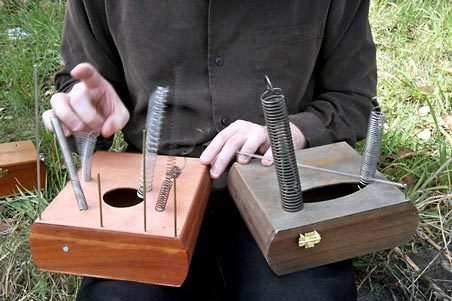
Barsotti: As far as the last part of that question, I don’t spend a lot of time worrying about those distinctions, so, no, maybe the differences are not all that important. I do think there is a commonality in my instrument building, my electroacoustic compositions, and my field recording. The electroacoustic compositions become the gathering point for all these different ideas.
Bach: Sure.
Barsotti: So, the two albums I have, Along These Lines, and Say “tin-tah-pee-mick”, are really a combination of all the things I’m engaged in.
There are field recordings, which involve going out to some place and capturing what’s happening. There are the recordings of objects that I deliberately interfere with to produce sounds that I wouldn’t put in the category of built instruments. For instance, I’ll record the sound of a can opener because I like the sound of a can opener. Then, there are my instruments. Finally, there is the instrument of the mixing console, having things spread out, and improvising. Earlier I made the remark that that’s how I got started.
Bach: Because you were a recording engineer, right?
Barsotti: Actually, I came from photography. I studied photography at the University of Illinois at Chicago, and then at the School of the Art Institute, way back in the late eighties. And when I got to the School of the Art Institute, I signed up for a video class, because that seemed like a logical progression in my narrative development. With that, I knew that there was a technology hurdle, in both video and audio, so I took a sound class. Well, the video class ended up not running, but the sound class did.
Bach: Serendipity.
Barsotti: It blew my fucking mind. The idea of thinking about sound in a way that I’ve never thought about before. My earliest pieces…we had four reel-to-reel four-track machines in the studio, a mixing console, and a very small collection of gear, like the SPX90, and the MidiVerb, and some processors and things like that, and a DAT machine, a cassette deck. The first thing I did was bring in my CD collection; the SPX90 had a looper, the sample and hold thing.
So, I started sampling little excerpts out of my CDs, finding things that would loop and feel a bit more continuous, as opposed to having a more repetitive nature. I’d load up sixteen tracks of this information, four on each of these four reel-to-reels. In groups of four they were synched, but the individual decks were not, so there would be variance from machine to machine in terms of timing. Then I’d run them to the console, and I’d set up some kind of effects chain, figuring out how to route to the MidiVerb and to the SPX90, and things like that. Came up with a mix to cassette, and then I’d crack my knuckles, hit play on all four machines, and go to town. They were all one-offs.
Bach: Exactly. They were performances.
Barsotti: They were. That’s where I came from. The recording engineer aspect came later after I got an internship at Experimental Sound Studio and learned way more about the ways of studios and working…and also I started teaching.
Bach: We were talking about the mixing desk as another instrument in your repertoire…
Barsotti: The electroacoustic compositions become this focal point where I can take field recordings, object recordings, instrument recordings, along with technology like mixing boards and tape machines and processing devices, which becomes a fourth sonic element. But the commonality between all of this, which is part of my lineage as a photographer…I didn’t know what it was until much later in my life…is this concept of reduced listening.
Bach: Schaefer.
Barsotti: Pierre Schaefer, musique concrète. What I found myself interested in was the quality of sound, period. The source was not relevant to me. I spent a lot of time thinking about whether I’ve been able to actually achieve reduced listening, and I don’t think I have completely. My interest in instrument building started after I’d find an object and say, “That makes a cool sound. So does this. I need to put them in one place so I can have access to them, interact with them.” I was interested in the quality of sounds they produced. And then the field recordings became the same thing. I started recording things because I liked the sound of this. What it was a sound of didn’t matter. I liked listening to it. And the same thing with the objects, and the process of taking sound and running it through an effect of some kind, coming up with some kind of processing chain; it was very aesthetic: “I enjoy this process, I enjoy listening to this.” The act of listening is the common thread, of being very interested in the quality of the sound regardless of whether it’s from a field recording or a processor.
Bach: That brings us to the idea of collaboration. One of the things we talked about in San Francisco was the idea of a summit. A Phonographers Union summit. Let’s get everyone together. Marcos [Fernandes] with the Tokyo Phonographers Union, Chicago Phonography, the New England group, SoCal, Seattle, and have a huge party. That’s an amazing idea, and I’d love to see that happen someday. That got me thinking about what kinds of activities could happen remotely; you’re in Seattle, I’m in L.A. Common ground could be San Francisco, maybe, but what kind of structure…because in the old days, someone would record something on a cassette tape, drop it in the mail, the second person would listen to it, and add to it. That’s still a valid approach.
Barsotti: There’s Dropbox.
Bach: Dropbox. What types of cool things could we do that would be fun and could incorporate the things you’re interested in, that I’m interested in.
Barsotti: We’d probably need to put more thought into it, but one thing that just occurred to me is that we can talk more about this idea of space. You alluded to the process of how your ensemble works in the space, and I really like your ideas about reverb and ambient space, and how your sounds blends with that and how those two things interact. The work that SPU has done in the hangar and the silo are all about that. An interesting thing happened in the hangar when we performed there. We had this huge debate about our monitoring setup. They wanted monitors in front of us so that we could hear ourselves. I said, “If you do that, you will fuck this project up. We will hear everything crystal clear, respond based off of that, and the audience will hear mud.”
Bach: Yeah.
Barsotti: I finally convinced them to set up our monitors 150 yards away. And we did a great job because we had to interact with the space. Every decision we made was dependent on what the space did to our sounds. When we started doing these small, local setups like you guys have been doing, it makes the sound work in the space in a very different way. I think there is something interesting in the concept of space, and one thing that occurs to me is this notion of re-amping.
Bach: Okay.
Barsotti: Taking sounds, maybe from each other, and bringing them into spaces and broadcasting them and recording them in different, interesting ways. The idea of getting sounds that I may not be familiar with or comfortable with and taking them down to Carkeek Park and figuring out a way to broadcast them in the marsh and then record them. Or take them to the studios at the Art Institute.
Chris [DeLaurenti] is coming into town again in November, and we’re going up to the Cistern in Port Townsend in Seattle [this session was subsequently canceled–GB]. It’s this big underground concrete bunker with an amazing sonic quality that has attracted all kinds of musicians. One of the ideas I’m working on now is re-amping through substance, like sheet metal [moves laptop’s camera to show instrument].

Bach: Wow, look at that.
Barsotti: I have two speakers connected to that. The speakers vibrate the metal, sending vibrations through the metal in different ways, and then microphones are placed in different locations to capture the vibrations. Ideally I’m looking towards a performance with this where I have four or five microphones tied to four or five speakers in surround, so as sound goes through the plate, different nodal points of vibration will give off different qualities, different timbres, and that will surround you…so re-amping through materials like that. I also have these tin cookie bins, and I’ve attached speakers to the backs of them, and I laced the inside with springs, and the speaker excites the springs, which yield more reverb and more space because of the tins, and I stick a mic on the other side, or a contact mic inside the tin, or something like that.
So that type of sound is fascinating to me. To be fair, the sound artist Toshiya Tsunoda …I have three or four of his albums, like Pieces of Air, and The Air Vibrations inside a Hollow. He went around and stuck microphones in crevices like a Coke bottle on the side of the road. “How does the world sound from the inside of a Coke bottle?” So, there’s a direct connection there.
[Update from Steve: “I did realize the performance with the sheet metal. As described, I set it up with the speaker drivers connected to it. I then placed four pencil condensers very close to the plate (5mm or so), in specific locations. Ran tones through the plate creating different vibrational patterns. As the patterns shifted, the sound shifted on the plate. The mics were run to four speakers surrounding the room. The sound shifted through the space as the tones shifted across the plate. Recorded the performance as a direct mix since recording the surround did not make sense.”]
Bach: Sure. We don’t have to solve it now. I see this project as an open-ended series of conversations. I’m thinking of this as simply the beginning of our talk. We’ll sit with it, ponder it, do our own thing, read the transcript later. Maybe establish another conversation after that, talk about stuff we didn’t get to. Send a couple of files back and forth and see what develops. Look at it as an experiment: “How did that work? I sent you three sounds, and you went into the woods and re-amped them; how did that work?” Let it evolve. That’s the organic process I envisioned for this project, and so far it’s how it’s been working out. We don’t have to solve anything right now.
Barsotti: I think that’s fine. Frankly, I’m quite content to let you guide how this proceeds. Whether it takes a long time or a short time. I think that’s a fine, organic way to think about this.
 ATLAS | BACH
You must be logged in to post a comment.